If you own or manage a commercial building in Raleigh, a roof inspection is not just a box to check — it’s risk management.
Unfortunately, many commercial roof inspections are surface-level. A contractor walks the roof, takes a few photos, notes obvious damage, and sends a short report. If there’s no active leak, the conclusion is often: “Looks fine.”
That’s not how Raleigh Roofer approaches it.
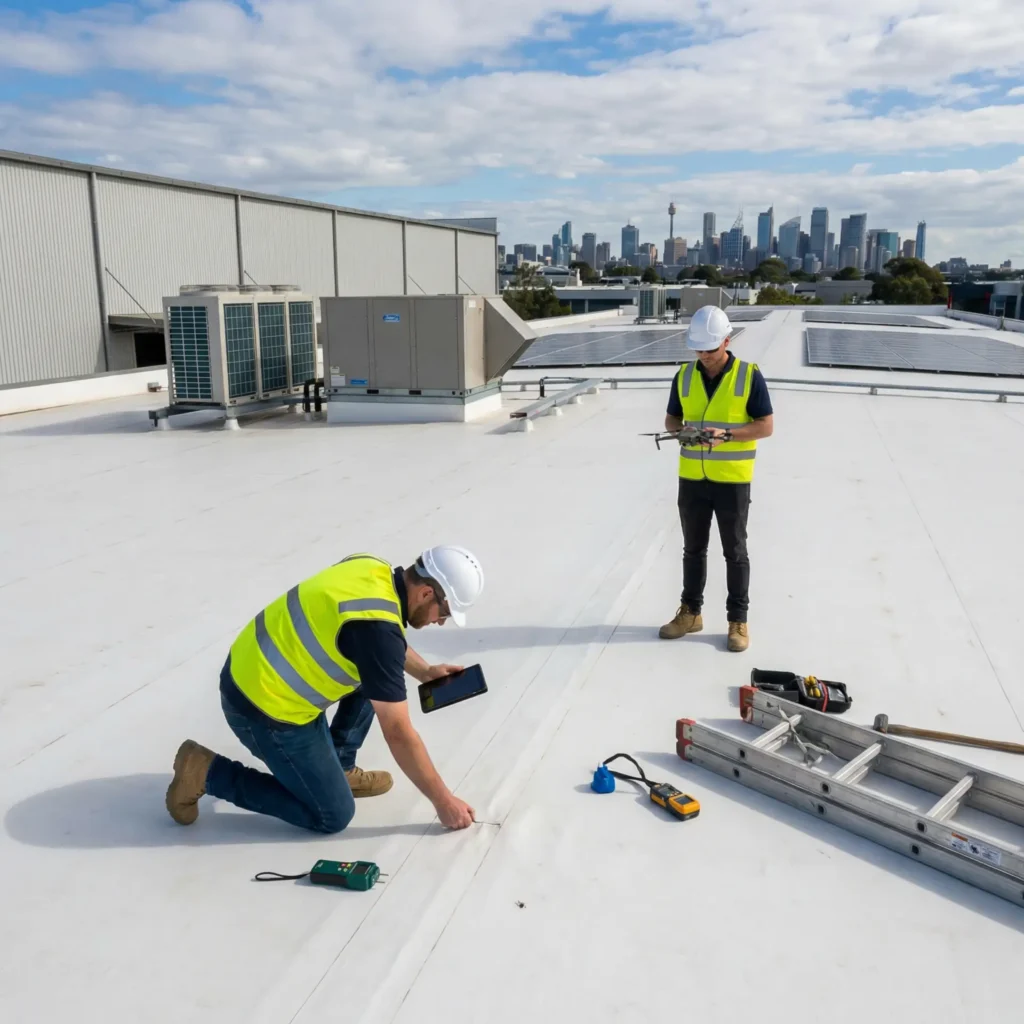
A commercial roof is a system. And when we perform a commercial roofing inspection, we’re not just looking for visible problems. We’re evaluating long-term performance, early-stage failures, and vulnerabilities that most contractors skip.
Here’s what we actually look for — and why it matters.
1. Seam Integrity Beyond the Obvious
On flat commercial roofs (TPO, PVC, EPDM), seams are the most vulnerable point in the system.
Many inspections simply check for visible separation. We go further.
Raleigh Roofer probe-tests seams to evaluate weld strength. We look for:
- Early edge lifting
- Fishmouth openings
- Weld voids
- Shrinkage tension at lap joints
- Membrane fatigue at termination bars
A seam doesn’t have to be fully open to be failing. Subtle separation can allow water infiltration long before interior leaks appear.
If you’ve read our breakdown on how commercial flat roof seams fail over time, you know that early detection makes a major financial difference.
2. Insulation Saturation — Even When There’s No Leak
Most contractors do not evaluate what’s happening beneath the membrane.
Water can travel laterally under a flat roof system for months. During a thorough inspection, we assess signs of trapped moisture such as:
- Soft spots underfoot
- Subtle membrane discoloration
- Insulation compression
- Drain-area irregularities
When necessary, Raleigh Roofer recommends infrared scanning or core sampling to determine the extent of moisture intrusion. This diagnostic approach prevents small issues from becoming large replacement projects.
3. Drainage Performance — Not Just Clogged Drains
Clearing debris from drains is basic maintenance. But drainage performance is more complex.
We evaluate:
- Slope consistency
- Low spots developing from structural settling
- Ponding patterns
- Drain flange integrity
- Tapered insulation effectiveness
Standing water doesn’t just look bad — it increases stress on seams and membranes. Over time, this accelerates deterioration and shortens overall lifespan.
Many property owners assume ponding is “normal.” Sometimes it is. But sometimes it signals structural movement or insulation compression that requires strategic correction.
4. Flashing and Penetration Details
Penetrations are the number one leak source on commercial roofs.
HVAC units, vents, skylights, conduit lines, satellite mounts — each one interrupts the membrane.
During inspections, Raleigh Roofer closely evaluates:
- Curb flashing attachment
- Pitch pockets
- Sealant degradation
- Counterflashing integrity
- Fastener back-out
- Parapet wall transitions
These areas are frequently overlooked because they require more time and close inspection.
Our team understands that commercial roofs often support complex mechanical systems. We inspect these intersections carefully because they are high-risk failure points.
5. Edge Metal and Perimeter Security
Wind uplift is a major concern in the Triangle, especially during severe summer storms.
The roof perimeter takes the most wind pressure. We check:
- Edge metal attachment
- Fastener spacing
- Termination bar security
- Parapet coping integrity
- Membrane pull-back
Loose perimeter detailing may not leak immediately, but it significantly increases risk during high-wind events.
If you’ve ever reviewed our discussion on commercial roof lifespan, you know edge integrity plays a larger role than most owners realize.
6. Previous Repair Quality
One of the biggest things most contractors skip? Evaluating past repairs.
We frequently see:
- Improper patch materials
- Incompatible membranes
- Excessive sealant use
- Poorly welded patches
- Layered repairs over failed sections
Not all repairs are equal. Some extend roof life. Others simply delay failure while creating more complex problems underneath.
Raleigh Roofer approaches commercial roofs diagnostically. If we see a repair that was poorly executed, we flag it — not to criticize another contractor, but to protect your building.
7. Structural Movement and Substrate Changes
Commercial buildings settle over time.
We look for:
- Subtle depressions
- Insulation compression patterns
- Fastener plate telegraphing
- Membrane stress lines
- Cracking near expansion joints
These signs indicate movement beneath the roof surface.
Ignoring structural indicators can lead to membrane splitting or widespread seam stress. Identifying them early allows for targeted corrective action rather than reactive replacement.
8. HVAC and Rooftop Equipment Impact
Rooftop units add weight, vibration, and traffic.
During inspections, Raleigh Roofer checks:
- Walkway pad placement
- Membrane wear paths
- Vibration-related seam fatigue
- Equipment curb condition
- Service technician traffic patterns
Commercial roofs are often treated like mechanical platforms. But without proper protection, repeated traffic shortens system life.
We don’t just evaluate roofing — we evaluate how the roof is being used.
9. Documentation for Insurance and Asset Planning
A proper inspection is not just about finding problems — it’s about creating documentation.
Raleigh Roofer provides:
- Photo documentation
- Condition summaries
- Risk area identification
- Budget planning guidance
- Repair vs. replacement analysis
For property managers and commercial building owners, this documentation supports capital planning and insurance communication.
If your commercial roof has not been evaluated recently, scheduling an inspection through our contact page ensures you’re not operating on assumptions.
10. Long-Term Strategy — Not Just Today’s Condition
Many inspections end with a simple statement: “No active leaks.”
That’s not enough.
We ask:
- How old is the membrane?
- How has maintenance been handled?
- Are seam repairs increasing year over year?
- Is insulation performance declining?
- Does replacement planning need to begin?
Sometimes a building doesn’t need immediate work — but it does need a 2–5 year strategy.
Raleigh Roofer works with commercial clients across Raleigh, Cary, Durham, and Apex to create forward-looking maintenance plans that protect budgets and operations.
Why Most Contractors Skip These Steps
Time and pricing pressure.
A detailed inspection takes longer. It requires experience and technical understanding. It may uncover uncomfortable truths about previous installation quality.
But commercial roofs protect:
- Inventory
- Equipment
- Tenant spaces
- Business continuity
- Insurance eligibility
Rushing through inspection is a false economy.
At Raleigh Roofer, we’ve built our reputation as a trusted Raleigh roofing company by taking inspections seriously. We don’t just glance at a roof — we study it.
The Real Cost of a Surface-Level Inspection
If seam fatigue is missed…
If trapped moisture is ignored…
If flashing deterioration goes unnoticed…
The eventual repair is more invasive, more disruptive, and more expensive.
Commercial roof failure rarely happens overnight. It’s almost always progressive.
A thorough inspection identifies that progression early.
Final Thoughts: Inspection Is Protection
Commercial roof inspections should not be rushed, simplified, or treated as routine paperwork.
They are one of the most important preventive measures you can take as a property owner.
At Raleigh Roofer, we inspect commercial roofs with the same level of care we would if the building were our own. We look for the subtle indicators most contractors skip because those details are what protect your asset long-term.
If it’s been more than a year since your last commercial roof inspection — or if you’re unsure how thorough that inspection really was — now is the time to take a closer look.
A proactive inspection today protects your building, your tenants, and your bottom line tomorrow.