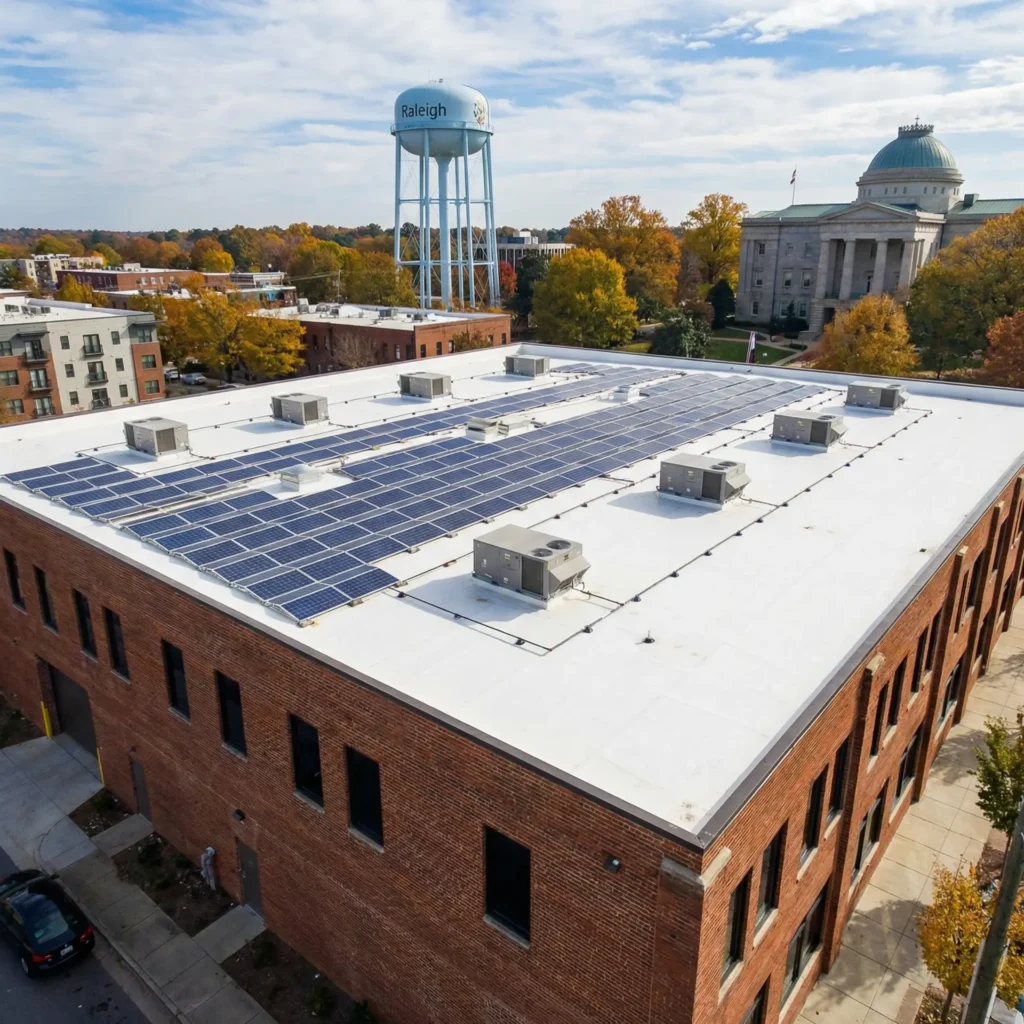
Commercial flat roofs are built to be durable, efficient, and cost-effective. But no matter how advanced the membrane system is — TPO, EPDM, or PVC — the most vulnerable point on the entire roof is almost always the seams.
At Raleigh Roofer, we’ve inspected and repaired countless commercial roofing systems across Raleigh, Durham, Cary, Apex, and the greater Triangle. And one pattern shows up again and again: seam failure is rarely sudden. It develops slowly, often invisibly, until water intrusion becomes obvious inside the building.
If you own or manage a commercial property, understanding how flat roof seams fail — and how to catch early warning signs — can save you from major interior damage, operational disruption, and premature replacement.
Why Seams Are the Weakest Point in a Commercial Flat Roof
A flat roof membrane is manufactured in rolls. On a commercial building, those rolls are laid out and joined together with heat welding (for TPO and PVC) or adhesive/seam tape systems (for EPDM). The integrity of the entire roofing system depends on those connections.
Even if the membrane material itself is in good shape, failed seams allow water to travel underneath the system. Once moisture bypasses the top layer, it can saturate insulation, deteriorate decking, and compromise structural components.
That’s why when Raleigh Roofer performs a commercial roofing inspection, seams are always one of the first areas we evaluate.
The Science Behind Seam Failure
Commercial flat roof seams fail for several reasons — and most of them develop gradually over time.
1. Thermal Expansion and Contraction
Raleigh’s climate plays a major role here. In the summer, rooftop surface temperatures can exceed 150°F. In the winter, overnight temperatures can dip below freezing. That constant expansion and contraction puts stress on seam welds and adhesive bonds.
Over years of cycling, this movement can weaken welds, especially if they weren’t perfectly installed to begin with.
2. Improper Initial Welding or Adhesion
Not all seam failures are age-related. Some begin on day one.
If seams were overheated, under-welded, contaminated with dust, or installed during improper weather conditions, their long-term strength is compromised. At Raleigh Roofer, we frequently uncover seam defects during inspections that trace back to original installation shortcuts.
This is one reason building owners turn to an experienced Raleigh roofing company instead of the lowest bid contractor.
3. Standing Water and Ponding Pressure
While minor ponding is common on commercial roofs, long-term standing water places stress on seams. Water is heavy. Over time, that pressure can encourage separation — especially along laps where insulation has compressed unevenly.
If you’ve ever read about ponding issues in our blog on why ponding water happens on flat roofs and how professionals fix it, you already know how water can accelerate deterioration.
4. Membrane Shrinkage (Especially with EPDM)
Some membranes naturally shrink as they age. This shrinkage places tension along seam lines and flashing details. Over time, you may see pulling at termination bars or separation at lap joints.
5. Rooftop Traffic and Equipment Vibration
Commercial roofs aren’t just weather barriers — they support HVAC units, vents, and service foot traffic. Repeated walking across seams, especially without walkway pads, can stress weld points. Vibration from rooftop units also contributes to gradual seam fatigue.
What Seam Failure Looks Like (Before It Leaks Inside)
One of the biggest misconceptions among property owners is that if there’s no visible interior leak, the roof is fine.
That’s not how seam failures work.
Water can travel laterally beneath a membrane for months before it appears inside. During a professional roof inspection, Raleigh Roofer looks for early indicators such as:
- Slight seam edge curling
- Fishmouth openings (small puckers in lap seams)
- Weld voids
- Discoloration along lap lines
- Soft spots indicating trapped moisture
- Insulation compression near seams
These subtle signs often appear long before interior ceiling stains.
The Cost of Ignoring Early Seam Separation
Commercial property owners often delay action because the roof “still looks okay.”
Here’s what actually happens when seam failure goes unchecked:
- Moisture infiltrates insulation.
- Wet insulation loses R-value.
- Energy costs increase.
- Decking begins to deteriorate.
- Mold risk increases.
- Repairs become more invasive.
By the time interior leaks appear, the damage beneath the membrane can be significant. What might have been a minor seam repair can evolve into a larger roof repair or even partial replacement.
At Raleigh Roofer, we frequently see commercial buildings in Raleigh where a simple early intervention could have prevented major disruption.
How We Test Commercial Roof Seams
Catching seam failure early requires more than a visual glance.
When Raleigh Roofer performs a commercial flat roof evaluation, we use a systematic process:
Probe Testing
We gently probe seam edges with specialized tools to test weld integrity. A properly welded seam should resist separation under moderate pressure.
Core Sampling (When Necessary)
In cases where moisture infiltration is suspected, core cuts may be performed to assess insulation condition beneath the membrane.
Infrared Moisture Scanning
For larger buildings, infrared technology helps identify trapped moisture that is invisible from the surface.
Perimeter and Penetration Review
Seams near edges, parapet walls, and penetrations are especially vulnerable. These areas receive detailed attention.
If you manage multiple properties, it’s worth reviewing your long-term maintenance strategy. Even our article on commercial roof lifespan emphasizes how proactive inspection extends system life significantly.
When Seam Repair Is Enough — And When It’s Not
Not all seam failures require full replacement.
If caught early, localized seam rewelding or patching may restore system integrity. However, if seam failure is widespread — especially due to systemic shrinkage or membrane age — broader corrective action may be necessary.
Raleigh Roofer does not jump straight to replacement. Our diagnostic-first approach ensures you understand whether you need a targeted repair or a more strategic plan.
For buildings nearing end-of-life conditions, a consultation about roof replacement options may make more financial sense than repeated seam patching.
Raleigh-Specific Factors That Accelerate Seam Wear
The Triangle presents unique conditions:
- High summer UV exposure
- Rapid temperature swings in shoulder seasons
- Heavy rain events
- Occasional ice events
- Dense pollen and debris accumulation
Flat roofs in areas like North Raleigh, Cary business parks, and downtown Raleigh experience different stress patterns depending on surrounding tree coverage, shade, and drainage design.
Raleigh Roofer has been working on commercial roofs in this region since the 1990s. We understand how local conditions impact seam performance over decades, not just years.
How Often Should Commercial Roof Seams Be Inspected?
For most commercial buildings in Raleigh:
- Annual inspection minimum
- Biannual inspection ideal
- Post-storm inspection recommended after major weather events
- Inspection before lease renewals or property sales
Routine inspection is significantly more affordable than emergency repairs. If you’re unsure of your roof’s current condition, scheduling a professional evaluation through our contact page is a practical starting point.
The Bigger Picture: Seam Health = System Longevity
Commercial flat roofs don’t usually fail all at once. They decline in stages. Seam degradation is often the first sign of that process.
By focusing on seam integrity:
- You preserve insulation performance
- You reduce risk of structural damage
- You avoid tenant disruption
- You extend overall system life
- You protect capital budgets
This is why Raleigh Roofer approaches every commercial roofing project — whether inspection, repair, or replacement — with a diagnostic mindset first.
If you’d like to understand more about how we evaluate roofing systems, you can also learn more about our approach on our about page or explore our broader commercial roofing services.
Final Thoughts: Catch It Early, Protect Your Investment
Flat roof seam failure is rarely dramatic at first. It’s subtle, gradual, and easy to overlook — especially when interior spaces still appear dry.
But beneath the surface, damage can already be developing.
Raleigh Roofer works with property owners, managers, and business operators across Raleigh and the Triangle to identify these vulnerabilities before they become major liabilities.
If your commercial flat roof hasn’t been inspected recently, or if you’ve noticed minor surface changes along seams, now is the time to act — not after a leak disrupts operations.
A proactive inspection today can mean years of extended roof life tomorrow.